Research at the Arvo Pärt Centre
I had the privilege of being selected for a two-month 2025 Nordic Music Residency at the Arvo Pärt Centre in Laulasmaa, Estonia. This would give me a perfect opportunity to develop Carrying the Cross of Creation after the initial performances at the 2024 Kalv Festival.
Here is my first report:
I began my residency at the Arvo Pärt Centre on February 16 2025 full of excitement and expectation. The programme is designed for artists working in music … to immerse themselves in an inspiring environment and create work specifically exploring local cultural landscape and traditions. Projects may address ecological, historical or cultural themes. In other words, it was tailor-made for my interests. But where would the residency lead me? And how would I know the way?
Shortly after my arrival a member of the Centre staff loaned me a copy of a book she thought I might find interesting: Poetics of Endangered Species. Estonia. A couple of sentences from Timo Maran’s preface to this beautiful work stood out as I began to study it:
“What could there possibly be in common between protecting nature, prayer, music, and old forgotten crafts of performance?” [Note that I have replaced “literature” with “music”, and added “of performance”.] … “When these four fields are intertwined, a new discipline can be born.”
The question in the first sentence is exactly the one posed to me by those sceptical of my ideas; and if birthing a new discipline is too vast a aim for this residency, taking even a few steps in the right direction would suffice.
Our current way of life is depleting the planet’s resources. Extractive rather than sustainable, it is no exaggeration to say that we will ultimately crucify the Earth. My project consists of preparing a performance on piano of Haydn’s sonata-cycle, the Seven last Words of Christ on the Cross, but with the voice of the Earth reinforcing the words of Christ as they echo across the centuries. If “protecting nature” is about my responsibility to look after the earth — even at this late stage in the process of climate degradation, “prayer” is about the attitude I adopt when playing music, one of the gifts we have been given to express our deepest longings. Haydn lived more than two hundred years ago, and I am looking for ways of using the flexibilities of early music performance to underline the extraordinary emotional depth of these seven sonatas. I believe that “old forgotten crafts of performance” can develop these flexibilities in terms of improvisational techniques remade for today’s audiences, enabling me to reimagine every single musical moment.
I have been hugely helped in this task by studying the works of Arvo Pärt; both those, like the Haydn, which are wordless but based on text (such as Silouan’s Song), and those which are based on ancient music or texts but are thoroughly contemporary in appeal (such as The Deer’s Cry and Da pacem, Domine). Mozart-Adagio has also been a constant source of inspiration in the way it creates a liminal dialogue between past and present, Mozart and Pärt.
I still have many unanswered questions: one of the largest is how to perform the gaps between the sonatas, which would originally have been filled by homilies. I am hoping to develop material that will encourage an audience to gain a deeper understanding of the plight we are in, while at the same time glimpsing hope on the horizon.
My forthcoming guided two-day visit to Estonian forests will definitely provide some valuable clues and set me on the right path for the second and final month of the residency.
—————
The visit to Estonian forests introduced me to some of the raw truths of forest destruction, as shown in this photo released by the Estonian Nature Foundation:
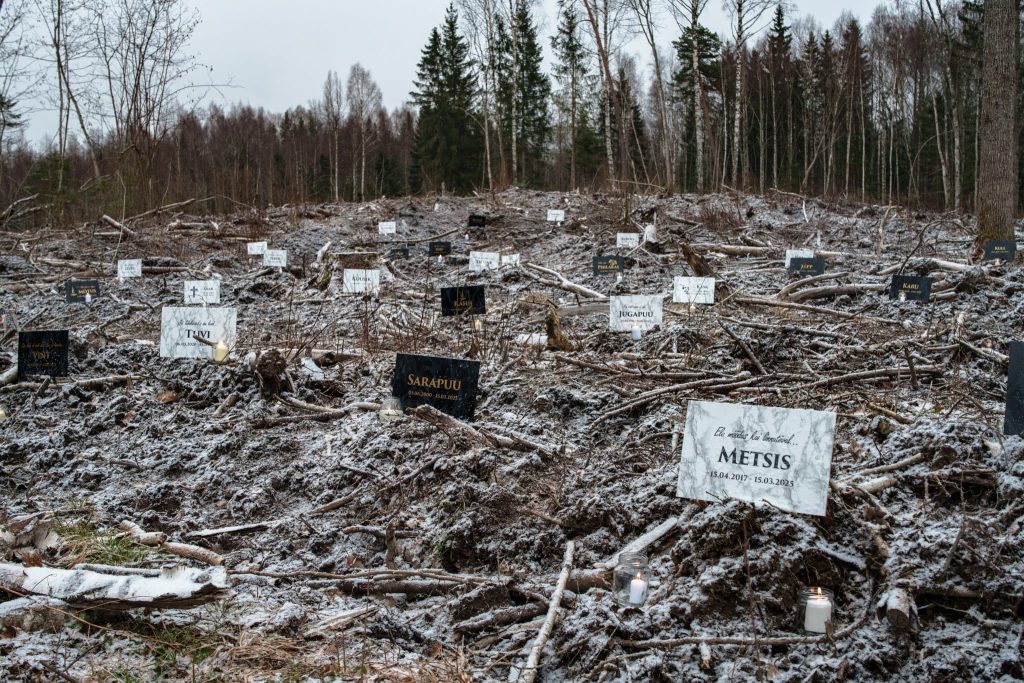
The residency enabled me to develop what had so far eluded me: a link between nature and Haydn’s sonatas. Several parts of my summary report after the second month of the residency expresses what I learnt:
In terms of what I have learnt in relation to my research project, I think the main one is how to put the whole performance of the Seven Last Words together in a structure that can (perhaps) make sense to an audience today. This involves my own disciplined practice of playing the piano, including understanding each phrase and each note, and being able to relate that understanding to what I am hoping to communicate to an audience.
I have also understood, or at least begun to understand, how the Haydn sonatas are connected with their own time, not just their own music-historical time but their own spiritual and environmental time, and how this often seems to be a forgotten aspect of such pieces. This means that my task as a performer is to reconnect myself to the land and to the music, so that I can situate my performance today within the clarity of those connections. I have played with the possible use of the idea that Haydn used a Jesuit technique, the composition of place, to help him imagine the various “scenes” represented in the Seven Last Words. If I were able to find out more about this technique, it could be a transformational practice for performances of music from the period. I have found that the practice also fits in with Haydn’s approach to Arianna a Naxos.
I have begun to understand working with my own hands, in terms of how I can prepare them for expressing themselves as part of my body, the part which makes contact with the keyboard, touches the notes and forms them into sounds. This is naturally an essential part of any performance. I am not ready to write an extended essay about it as yet, but I do know that hands are mentioned not only by actors and theatre people of Haydn’s time, but also by theologians of differing traditions.
Trial performances
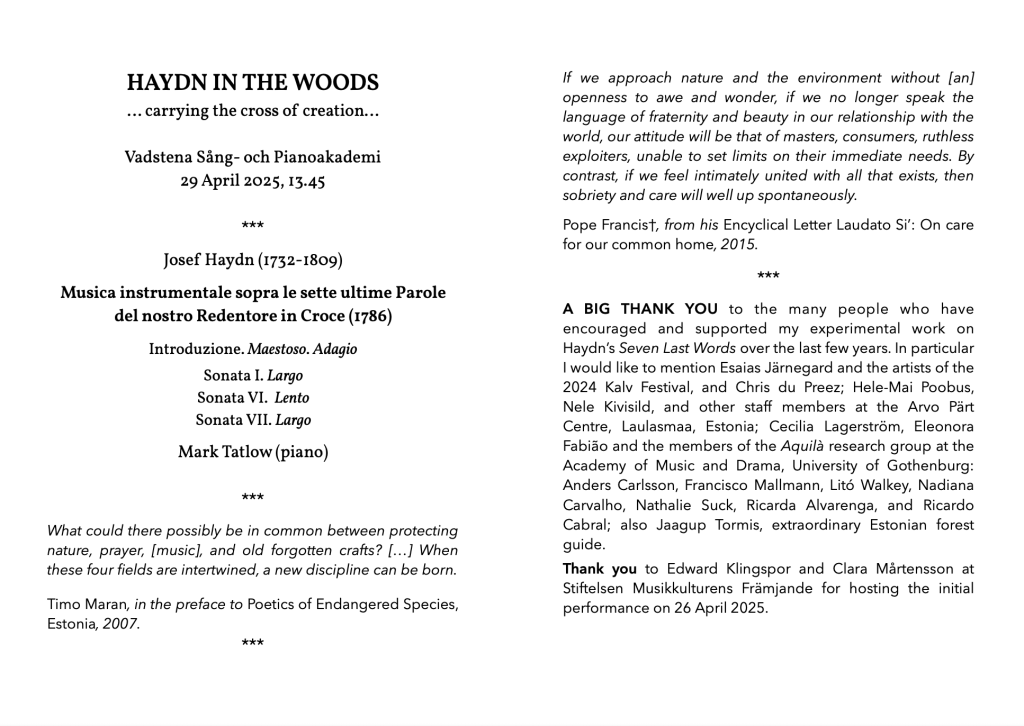
I had the opportunity to try out part of the performance at a lunch-time lecture-recital at the Arvo Pärt Centre during the residency, and then on 26 April at Stiftelsen Musikkulturens Främjande in Stockholm as part of their Culture Night programme:
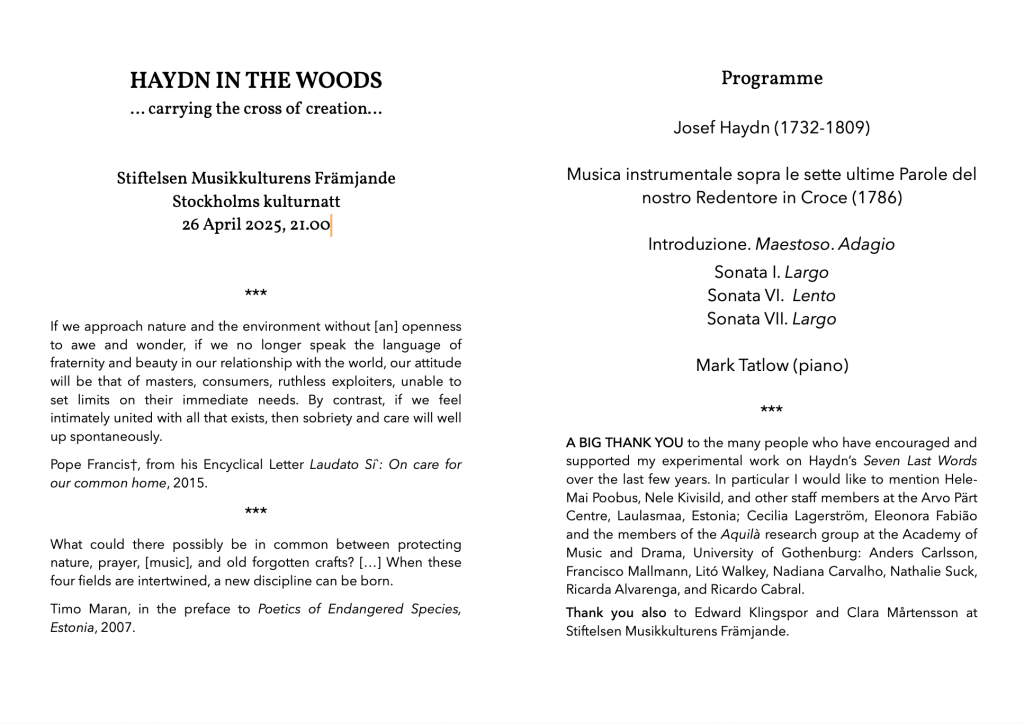
This was the first time that I was able to present the material in a semi-finished form, and integrate it with the practice of cleansing my hands that I had discovered while in Laulasmaa. Here is the concert text, in which I was able to integrate many of the insights I had discovered during the different phases of my research. The text is an essential complement to the performances
Welcome to this concert! My name is Mark Tatlow and I’m going talk about, and play extracts from, Haydn’s sonata cycle, the Seven Last Words on the Cross. Originally written for orchestra, the Seven Last Words is more familiar today as an oratorio with choir, or in the arrangement for string quartet.
This evening I will be play from an eighteenth-century arrangement for keyboard. I’ve been fascinated by the Seven Last Words for nearly ten years, not least because I felt that at the centre of this work lay a composite question I wanted to answer:
— has it anything to say to us today, and if so what?
The question arose in 2018 after playing the whole work in public for the first time. Not the most difficult pieces to play in terms of the notes on the page, but it is hard to make sense of their content. The work consists of a prelude, seven sonatas, and a postlude based on the Seven Last Words that, according to the Christian Gospels, Jesus spoke from the Cross. The work was originally commissioned by the Jesuit priest of a small oratory church in Cádiz, Spain, for a Good Friday service in 1786. Between the sonatas the priest would have preached short sermons. When performing them in 2018, however, I interpolated poems instead. I chose a suite of poems by British poet Ruth Padel, specifically written to articulate and contextualise the ancient words and their story today, but I was neither convinced by them, nor by my playing. So I was very glad when, last year, I was given the opportunity to take a second look at the sonatas, performing them one by one in eight separate events at the Kalv Festival in Western Sweden.
The theme of the festival was pilgrimage, and while preparing myself, a short phrase came into my mind: Carrying the Cross of Creation. It combined the idea of walking with a cross (as Jesus did in the ancient Gospel account) with an allusion to what humans are doing to creation today, that we are, in effect, crucifying it.
Haydn’s postlude is a musical earthquake, which represents what took place the moment that Christ died, when the temple curtain was rent in two, the ground shook, graves opened, and the dead arose, as a foretaste of the resurrection which, according to the Christian story, celebrates the defeat of death itself. I realised that the large earthquake that took place in Lisbon, Portugal in 1755, could be seen as a reflection of this ancient earthquake. The effects of the Lisbon event were felt far and wide, and in Cádiz, over 500 km away, there was a huge tsunami wave. This physical wave was itself reflected over the following years in a series of ground-breaking essays by philosophers such as Voltaire, Rousseau and Kant, who debated whether or not it was a sign of God’s judgement, or whether it suggested that God was, in fact, an absent creator, or if indeed he existed at all… So “earthquake” — as a contemporary reality — was an important point of philosophical and theological discourse when Haydn wrote his sonatas in 1786.
Today we are on the cusp of yet another climate catastrophe, which many believe will be worse than any the earth has so far experienced. To meditate on these sonatas, to listen to them, as if they were the last words spoken by the Earth as it approaches a catastrophe, could therefore be an appropriate exercise.
In the original story, however, the earthquake was not the end: it was a harbinger of new life. Some thinkers today feel that this will also be true of the coming climate catastrophe. And Haydn, in opening up a discursive musical space, also seems to glimpse the hopeful possibility of a positive outcome. Although the sonatas are unrelentlessly serious, each of them contains hints that there will be light at the end of the tunnel. The question is whether we are attentive enough to notice!
I will now set the emotional scene for the sonatas by playing the introductory movement.
[Introduzione]
Each of Haydn’s seven sonatas is headed by a “word”. Actually not by just one word, but by a word in the sense of a sentence. The first is “Father, father, forgive them, for they know not what they do”: Christ asking God to forgive those who are crucifying him; the Earth asking her creator to forgive us for what we are doing to her.
(It was, incidentally, International Mother Earth Day last Tuesday, 22 April).
When I say “us” and “we”, I am aware that there may not be anyone in this room who has ever deliberately harmed the Earth. But thinking of myself, I realise that I am inescapably, and inextricably entangled with what is happening to the Earth and to its climate today.
— I can’t stop using plastic that is released into the environment.
— I can’t stop greenhouse gases escaping.
— I can’t stop forests such as the Amazon being destroyed.
When I play these sonatas, in the way I propose, I am aware that I do not have clean hands.
[START PREPARING TO WASH MY HANDS]
I recently returned to Stockholm after two months at the Arvo Pärt Centre in Laulasmaa, near Tallinn in Estonia, as one of four Nordic Music Residency artists 2025. The Residency theme was to look at the relationship between music and ecology. Western European classical music culture has often existed at one remove from nature, creation or the “land”, it increasingly developed universal appeal partly by distancing itself from the “local”, unlike music and song in indigenous cultures. The threads of connection with creation often remained intact, if hidden, and I wondered if I could recover just a few of them through working on the Seven Last Words while in Laulasmaa.
In the 1790s Haydn became the first real musical superstar, whose music travelled throughout Europe, and beyond. For several years during the 2010s, Arvo Pärt was considered the most popular classical music composer of the day — in terms of the number of performances he received; and his music has enabled many to recover a sense of oneness with each other (and with creation), perhaps because he is so aware of what has “gone wrong” in our attitudes to each other and the creation.
You may have noticed that I have been washing my hands in a brown-coloured liquid… It is the extract of young pine needles from trees in the forest that surrounds the Arvo Pärt Centre. I wanted the forest (that we are destroying) to cleanse my hands, so that when my fingers touch the keys, I am reminded of the proximity of my fragile life, to the fragile life of the earth: the earth that bore the cross of Christ, that quaked as a result, that caused the tsunami in Cádiz, the earth that Haydn enjoyed while walking in the woods.
Here now is the first sonata: “Father, forgive them, for they know not what they do.” “Mother, forgive us, for we know not what we do.”
[FIRST SONATA]
I wonder:
— How did Haydn’s audiences listen to music like this? Did they use a special technique? or did they just listen as we sometimes do, entertained, while placing the music somewhere on a scale between beautiful and boring? During my two months at the Arvo Pärt Centre, I tried to find answers to these questions… After all, the Seven Last Words became one of Haydn’s most popular works. Why?
Haydn’s commission was for a set of sonatas based on words, but without the words being sung. This is a technique used by other composers too, from Beethoven, Mendelssohn, to — not least — Arvo Pärt himself.
In Haydn’s case the melodic “theme” that opens each sonata is a setting of the Latin text of each “word”. The Latin of the first phrase (“Father, Father, forgive them, for they know know what they do”) is “Pater, Pater, dimitte illis quia nesciunt quid faciunt”:
[DEMONSTRATION 1]
Whenever that phrase or part of it returns, it refers to those specific words, but each time situated in a different emotional context; as we travel through the sonata Haydn lets us hear a depiction of the various feelings those words aroused in him.
There is more too… Haydn, and many in his audiences, were likely to have been aware of a Jesuit (Ignatian) meditative practice called compositio loci — the composition of place. In its original form, it works something like this: you hear or read a story (usually from the Bible), look at an image of it, and then “compose the place” in your own mind, with the help of your imagination.
In the case of the Seven Last Words, the “place” of each sonata would have been familiar to the original audience. The music would have enabled them, in their minds to walk around the scene, as if they were actually there, enabling them to “compose” it, the place, in their imagination. You might like to try out the technique in the next sonata I will play (no 6):
“Consummatum est” (“It is finished”),
In the original “place”, the hill of Calvary, there would have been three crosses, with Christ in the centre. As you picture this in your mind’s eye, let that cross become the cross of creation… And hear the text “It is finished” coming from deep inside the Earth. The melody is short:
[DEMONSTRATION 2]
It is about pain, but, as you will hear, also relief. Because “it is finished”, there is nothing more to say… except that, after a pause, Haydn’s music directs us to glimpse the promise of a brighter future… Perhaps it’s in the colour of the sky…. It sounds like this:
[DEMONSTRATION 3]
Towards the end of the sonata, the bare octaves of the original theme are clothed in new harmonies, and the tragedy of crucifixion is turned into the triumph of resurrection! The death of Death itself opens the way into a new future. Could that even be the case today, could the climate catastrophe — which risks destroying the earth — open up a new beginning for generations as yet unborn? How then should we live today?
[SONATA VI]
We have time for just one more sonata, no 7, the final “Word” before the earthquake. We don’t yet know for certain when or whether there will be a future climate catastrophe in our lifetime. In the original story, after he has said “Consummatum est”, there comes a moment when Christ, when the Earth (in our story), simply accepts what has happened and says, “Father / Mother, into your hands I commend my spirit.” What picture do you think Haydn might have had in his mind when he wrote this music?
[SONATA VII]
Did you hear the dancing? The future is up to us… Thank you!
—————
I also had the opportunity to present the same programme for the students of the Vadstena Song and Piano Academy on 29 April: